
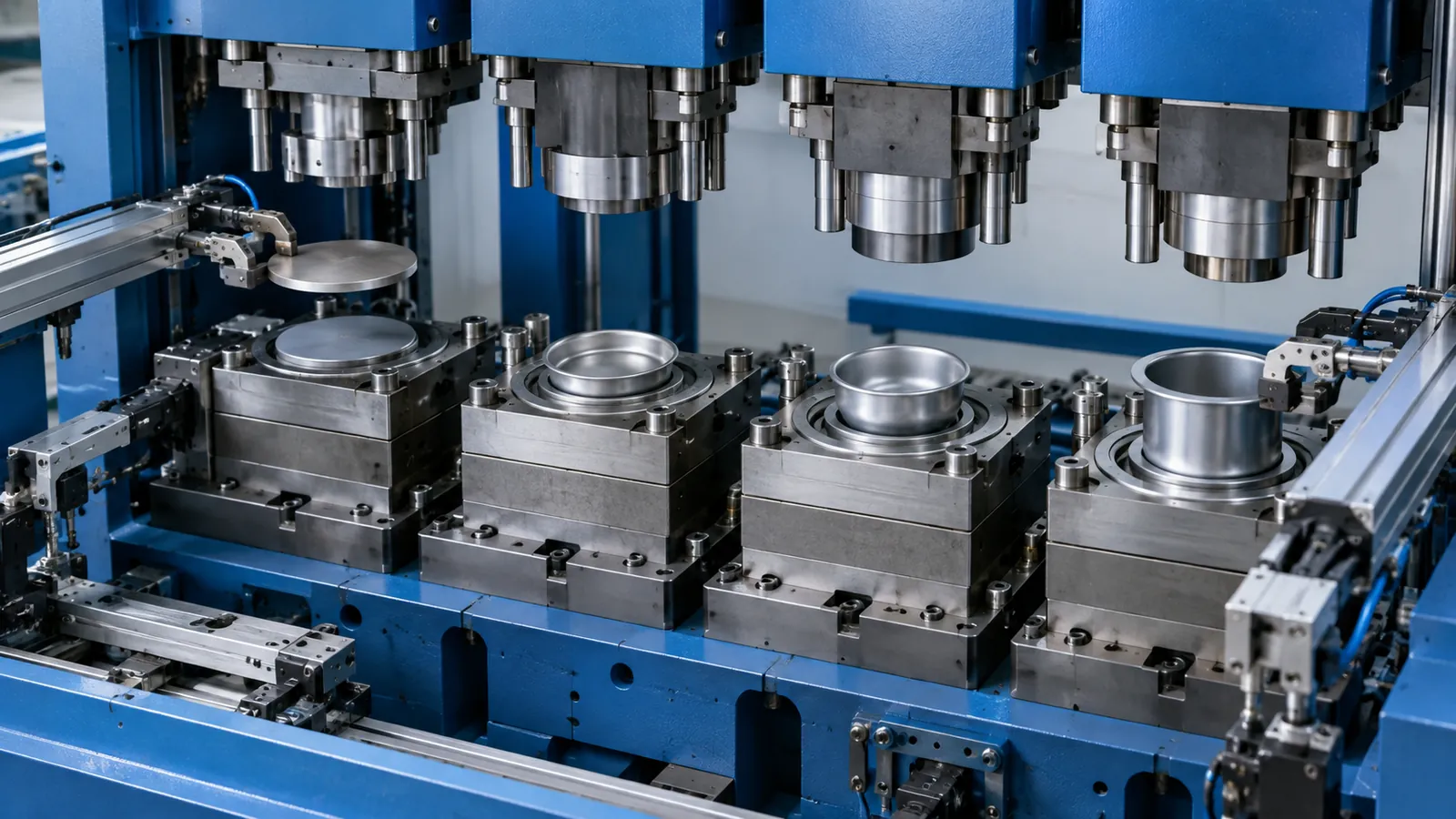
Choosing between a progressive die and a transfer die depends mainly on part geometry, production volume, material and the forming operations required. A progressive die usually delivers higher productivity in long runs, while a transfer die offers greater geometric freedom and may be better suited to complex, large or deep-drawn parts.
In this guide we compare progressive and transfer dies from a Design for Manufacturing (DFM) perspective to determine which system is most appropriate for each cold stamping project.
What is the difference between a progressive die and a transfer die?
In the industrialisation of metal components by cold stamping, the choice between progressive tooling and a transfer system is one of the most critical decisions for both the technical feasibility and the profitability of the project. From a Design for Manufacturing (DFM) perspective, this choice should not be postponed to the final quoting or tool-building stages; it must be built into the conceptual design of the part.
A mistake in the die architecture translates directly into material waste, oversized tooling costs, press bottlenecks and unforeseen geometric constraints. The aim of this guide is to provide a rigorous decision framework based on three key variables: part geometry, annual production volume and the complexity of the operations required.
The essential difference lies in how the part is transported between stations: in a progressive die it remains attached to a strip or carrier until the last operation; in a transfer die it is handled as an independent blank, which allows it to be reoriented between stations.
How does a progressive die work?
The sheet is supplied from a coil through an automatic feeder. The part moves between stations attached to a strip (skeleton or carrier). Cutting, piercing, drawing and bending operations take place simultaneously with each press stroke, and the finished part is only separated at the last station by cutting or release.
How does a transfer die work?
The part is first cut into an independent blank or separated from the strip at the first station. Transport between successive stations is carried out by mechanical or servo-driven transfer bars fitted with grippers, suction cups or magnets. As there is no connecting strip, the part can be freely oriented and positioned at each forming step.
Progressive die vs transfer die: selection criteria
1. Geometry and degrees of freedom
The geometry of the component sets kinematic constraints that determine the transport method:
Need for rotation and reorientation
When a part requires operations in several spatial planes (opposing flanges, draws on non-parallel faces or side piercing), the progressive die has significant limitations. Any deformation that excessively distorts the strip compromises the feed pitch and dimensional accuracy.
By contrast, the grippers of a transfer system can rotate, flip or tilt the part between stations, making deep symmetrical or asymmetrical draws and complex flanging much easier.
Draw ratio and deformation
Deep-drawn parts require material to flow in from the outer perimeter. In a progressive die this flow is restricted by the carriers or tabs connecting the part to the strip, requiring complex relief cuts that weaken the strip and increase the risk of breakage. In a transfer die, because loose blanks are handled, material flows freely under the blank holder, reducing residual stresses and excessive wall thinning.
Dimensions and thickness
Parts with a large envelope (over 400–500 mm) or high thickness require considerable forming forces and bolster sizes. The mass of a progressive die of these dimensions calls for high-tonnage presses with exceptionally wide beds. A transfer system allows these operations to be distributed across independent modular dies mounted in tandem or in a single-block transfer die.
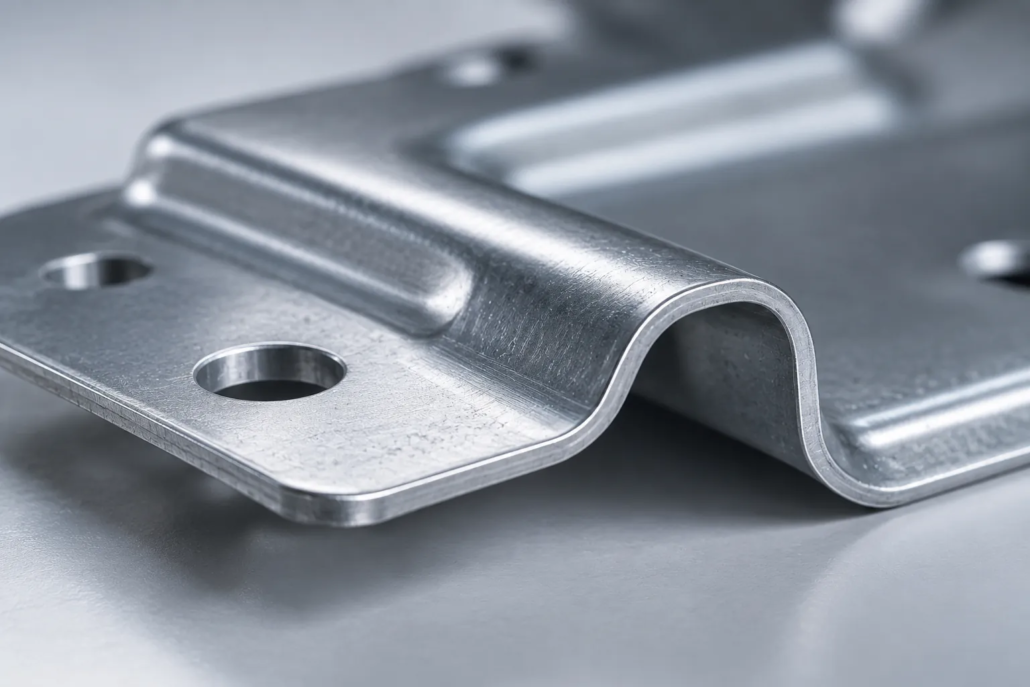
2. Production volume and return on investment (ROI)
Economic analysis in DFM requires weighing the initial investment cost (CapEx) against variable unit costs (OpEx):
| Parameter | Progressive die | Transfer die |
|---|---|---|
| Typical production rate | High (40 to 120+ strokes/min) | Medium-low (15 to 45 strokes/min) |
| Initial tooling investment | Medium to high (single block) | High to very high (kinematics and grippers) |
| Material utilisation | 50% – 75% (strip scrap) | 75% – 90% (blank optimisation) |
| Flexibility for modifications | Low (affects the whole strip) | Medium (independent stations) |
| Annual break-even point | Typically > 100,000 parts/year | Viable from 30,000 to 80,000 parts/year* |
* Especially for parts where raw material savings from blank optimisation offset the lower production rate.
For very long runs where cycle time is the key metric, the speed of a progressive die is unbeatable. However, for high-strength steel or expensive alloys (such as stainless steel, aluminium or copper), the scrap left in the progressive carrier strip can raise the unit cost to the point where a slower transfer die with optimal blank utilisation becomes more cost-effective.
3. Operational complexity and integration
Complexity lies not only in the shape of the part, but also in the number and nature of secondary processes:
- In-die secondary operations: In-die tapping, insertion of studs or nuts and riveting are usually integrated more compactly and stably in progressive dies, where the strip position is rigidly referenced by conical pilots.
- Perimeter trimming and sizing: Parts that require continuous 360-degree perimeter cuts without cut marks or carrier witness marks are natural candidates for transfer. In a progressive die, the point where the strip joins the part always leaves a witness mark (burr/tab mark) that may require subsequent machining or fail to meet tolerances.
- Force distribution and off-centre loading: Dies with highly asymmetrical forces generate tilting moments on the press slide. In modular transfer dies it is easier to centre individual loads, balancing forces with independent nitrogen cylinders at each station.
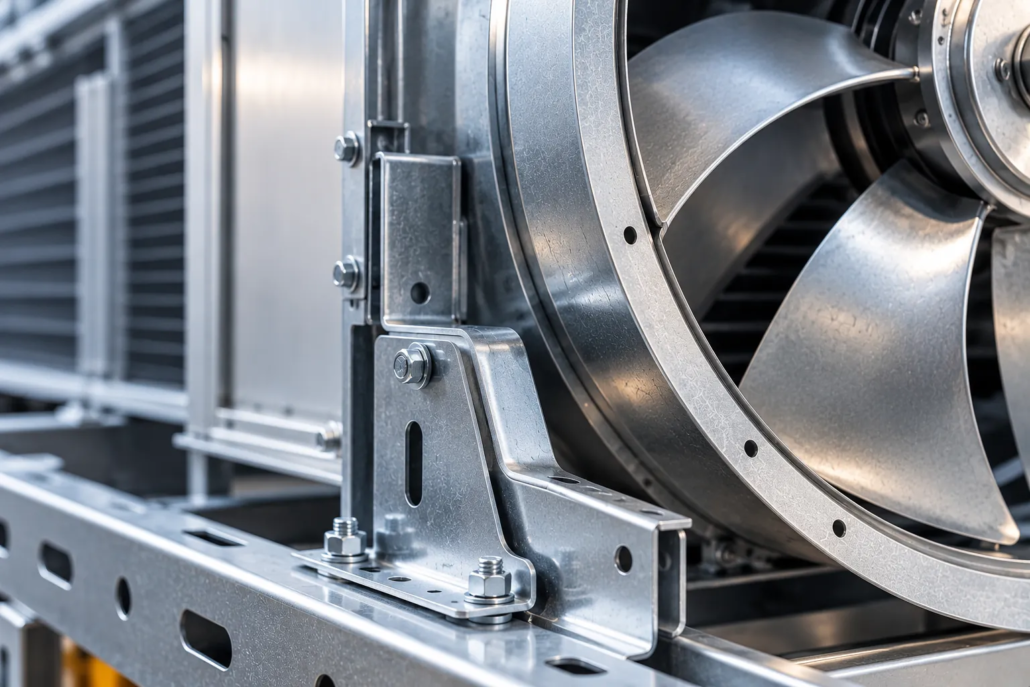
So, when should you choose one or the other?
When to choose a progressive die
A progressive die is usually the most suitable option when the part can remain coplanar during forming, a residual witness mark from the strip connection is acceptable and the project demands a high production rate in long runs. It is also particularly attractive when secondary operations are integrated into the die itself.
When to choose a transfer die
A transfer die has the advantage when the part needs to be rotated or reoriented, involves deep draws, requires a clean perimeter without carrier marks, or when making the most of an expensive raw material has a decisive impact on unit cost.
Decision table: progressive or transfer?
Use this technical checklist during the design review stage:
- Can the part remain coplanar throughout forming?
- Yes: candidate for a progressive die.
- No (requires rotation or opposing three-dimensional deformation): transfer die.
- Is a residual cut witness mark acceptable on the final perimeter?
- Yes: progressive.
- No (100% clean perimeter): transfer.
- How much does raw material weigh in the total cost of the component?
- Low: progressive (prioritises speed and hourly output).
- High (expensive material or large format): transfer (prioritises strip/blank yield).
- What is the committed annual volume?
- Over 250,000 units with a small/medium size: progressive.
- Medium runs with pronounced drawing or a medium/large size: transfer.
Conclusion: progressive die vs transfer die
The boundary between progressive and transfer dies is not rigid, but anticipating the decision during product design saves costly iterations. Incorporating generous bend radii, simplifying flange orientation and providing clamping areas for the carrier strip can make it possible to produce in a progressive die parts that initially seemed suited only to transfer.
Conversely, forcing a geometrically complex part into a progressive die will lead to unstable strips, frequent press stoppages and poor tool life. The golden rule of DFM for cold stamping is clear: design the part with the sheet transport method in mind as much as its final mechanical function.
EDSAONE’s experience with progressive and transfer dies
EDSAONE manufactures metal components by forming on mechanical presses of up to 500 t and hydraulic presses of up to 400 t, working with progressive, transfer and parametric dies. This capability allows us to handle both high-productivity processes and deep-drawn parts and geometries that require specific forming strategies.
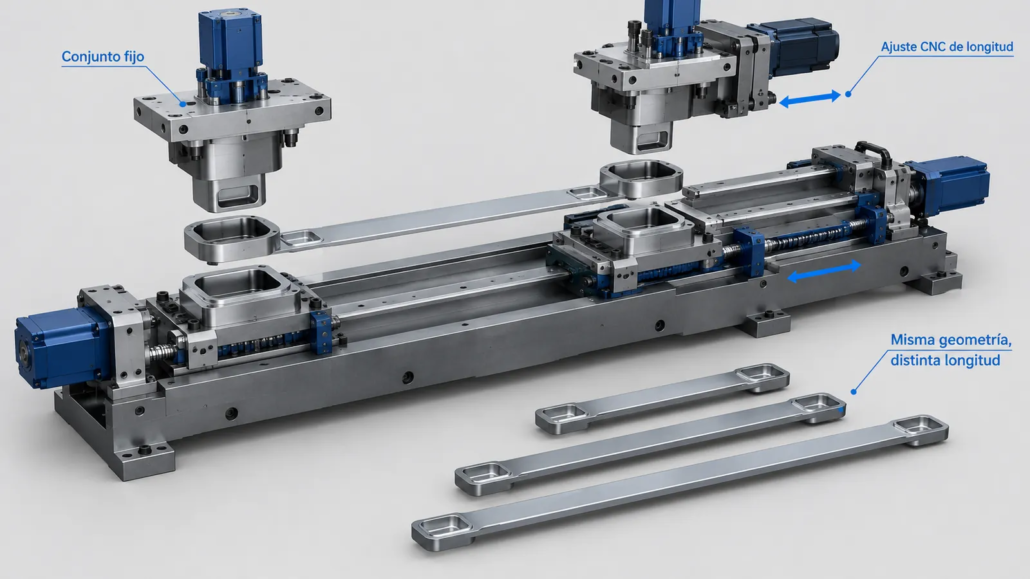
Analysing geometry, material, expected volume and required operations from the industrialisation stage makes it possible to select the most suitable manufacturing option for each component.
Do you have a part you need to industrialise? Send us the drawing and we will study the most suitable manufacturing option.


