
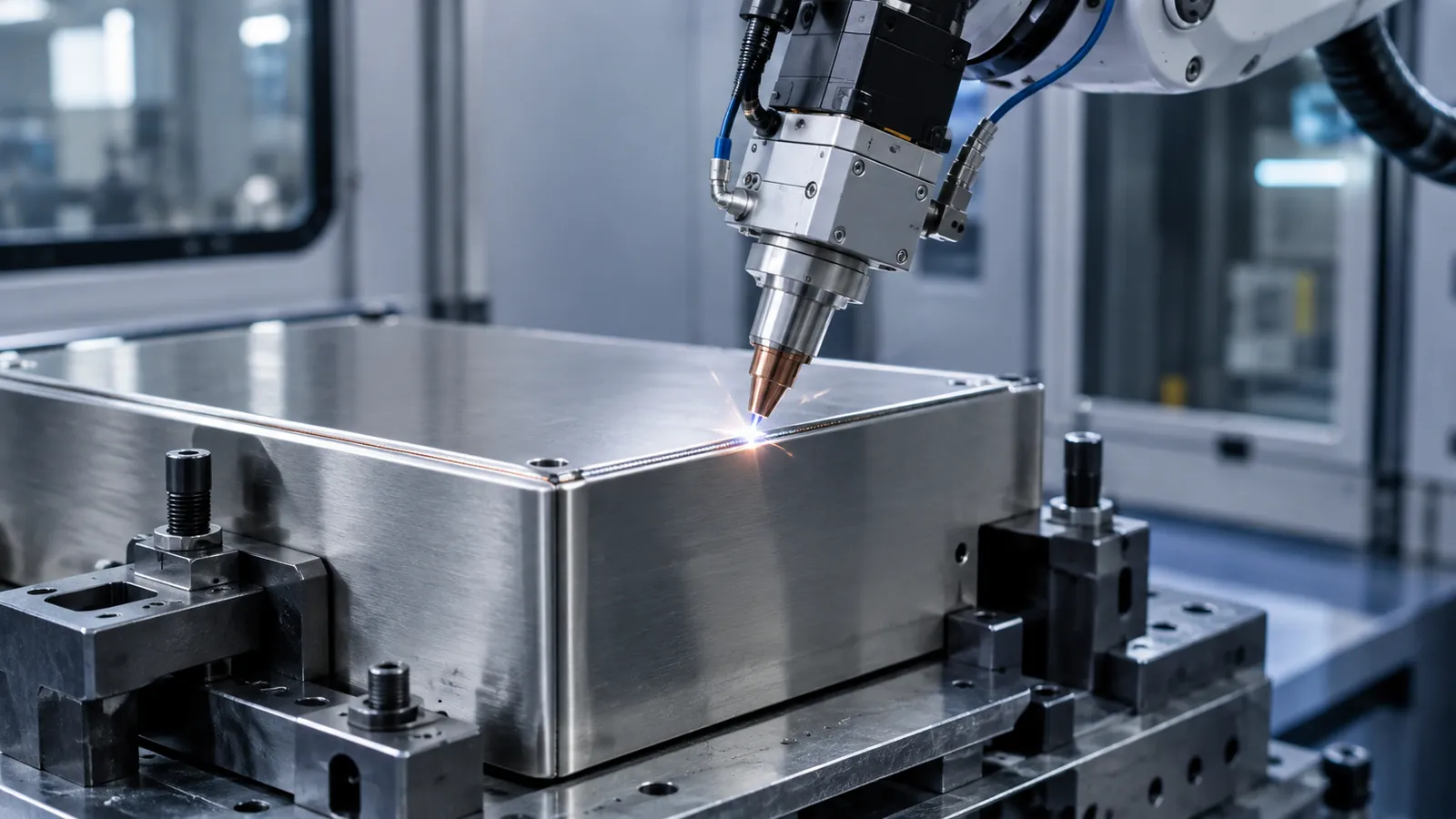
Choosing between laser welding and other joining technologies such as MIG/MAG, TIG or clinching means weighing precision, cost, tolerances, finish quality and production volume. Laser welding can offer high speed and low heat input, but it is not always the most suitable option for a given part or assembly. This guide compares the processes from a Design for Manufacturing (DFM) perspective and explains the criteria for selecting the most appropriate joining technology.
What are the differences between laser welding and other joining technologies?
In the design and manufacture of metal components, laser beam welding (LBW) is often seen as the gold standard of quality: extremely narrow seams, impressive travel speeds, a minimal heat-affected zone (HAZ) and a finish that virtually eliminates subsequent grinding.
However, in a real production environment, laser is not always the optimal answer, either technically or economically. Its high energy density requires millimetre-precise fit-up between parts (an almost zero joint gap) and a level of investment in cells, optics and safety far higher than that of conventional arc processes (MIG/MAG or TIG) or cold mechanical alternatives (clinching and riveting).
From a Design for Manufacturing (DFM) perspective, opting for laser welding should not be driven by technological prestige, but by a rigorous profitability equation: do the savings from eliminating thermal distortion, removing secondary polishing operations and increasing welding speed offset the geometric demands on part preparation and the higher cost of tooling amortisation? This guide analyses the technical and economic criteria for deciding when laser is unbeatable and when another joining technology is the better choice.
Factors to consider when choosing between laser welding and other joining technologies
To assess whether laser is suitable compared with conventional processes, the engineering team should review four critical project variables:
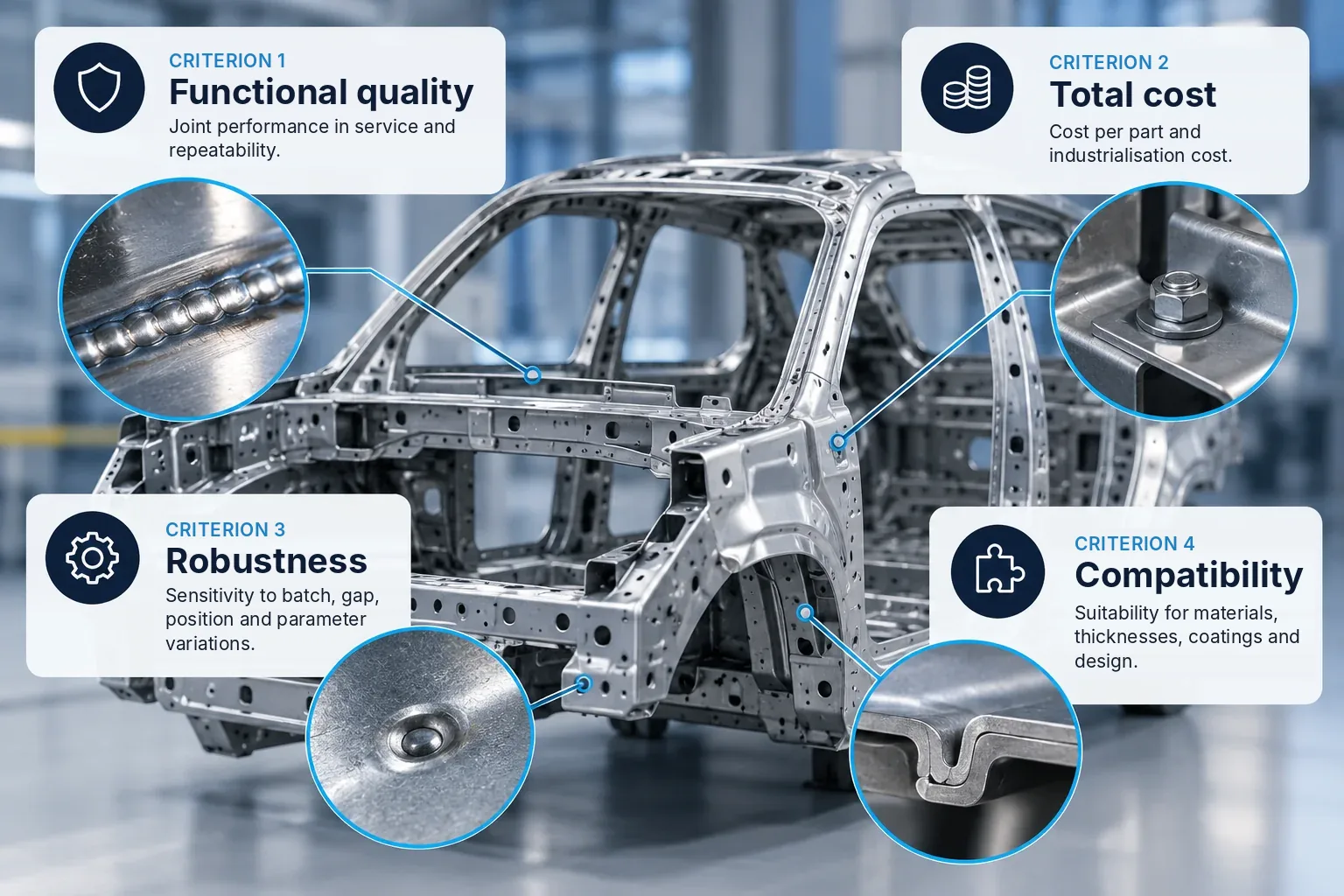
Material thickness and penetration geometry
- Thin and medium sheet (0.5 to 4.0 mm): This is the undisputed domain of the fibre laser. It allows welding at speeds of between 2 and 8 m/min with full penetration in keyhole mode, drastically minimising the energy input per unit length.
- Heavy thicknesses (t > 6 to 8 mm): As thickness increases, keeping the laser weld pool stable requires high power (≥6–10 kW) or hybrid laser-arc architectures (HLAW). In this range, MIG/MAG welding remains much more economical, robust and tolerant of edge preparation deviations.
Tolerance to joint gap
This is the most unforgiving technical filter for laser welding:
- The focused beam diameter is very small (typically between 0.1 mm and 0.6 mm). If the gap between the sheets exceeds 10% of the sheet thickness or 0.15–0.20 mm, the beam passes through the joint without melting the edges, causing undercut, lack of fusion or continuous burn-through.
- If the parts come from stamping with springback variations or from conventional cutting with burrs, ensuring that joint gap requires costly over-constrained clamping fixtures or laser systems with beam wobble and hot-wire filler.
- If fit-up tolerance cannot be kept below 0.3–0.5 mm, manual MIG/MAG or TIG welding becomes substantially more viable thanks to its natural ability to fill gaps with filler material.
Thermal distortion and finish quality
- Critical distortion: Traditional arc welding introduces distributed heat that inevitably distorts slender stainless steel or aluminium assemblies, requiring hydraulic straightening presses and hours of skilled work with a torch. The laser HAZ is 3 to 5 times smaller, ensuring dimensional stability without rework.
- Finish quality: In sectors such as premium HVAC, metal furniture, visible automotive parts or electronics enclosures, the laser seam is smooth, uniform and free of spatter, eliminating 100% of the deburring, grinding and brushing required with MIG.
Production volume and automation
- The cost per linear metre of laser welding is minimal in high-rate automated or robotic operations.
- However, for prototypes, one-off repairs or heavy fabrications with welds in awkward positions and variable geometries, the flexibility and low cost of TIG or MIG equipment far outweigh the rigidity of a laser cell.
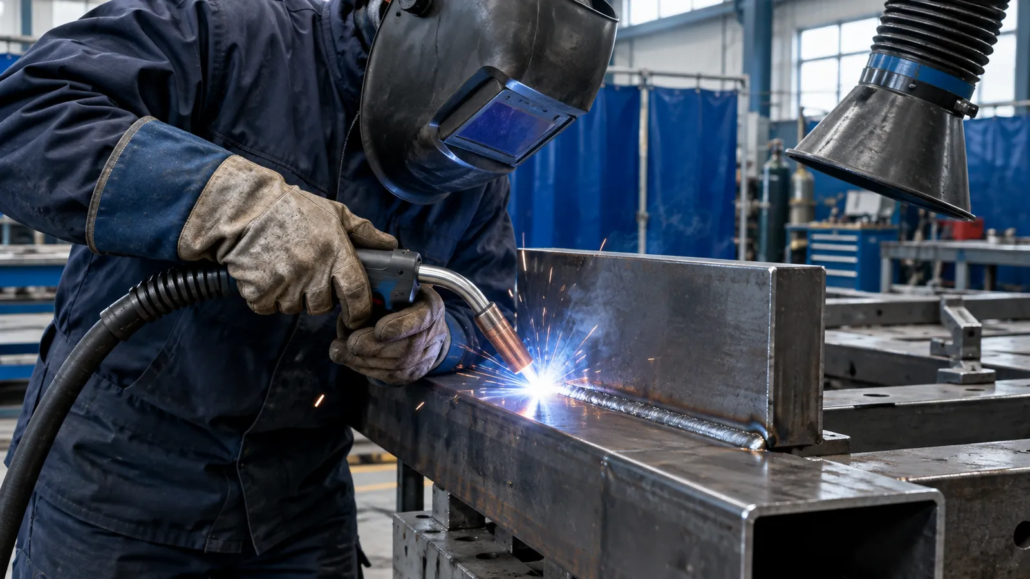
Laser welding vs MIG/MAG, TIG and clinching: comparison table
| Selection criterion | Laser welding (LBW) | MIG/MAG welding | TIG welding (GTAW) | Mechanical clinching |
|---|---|---|---|---|
| Heat input / Distortion | Minimal (very narrow HAZ) | High (significant warping in thin sheet) | Medium-high (local distortion) | None (cold forming) |
| Process speed | Extremely high (2 to 10 m/min) | Medium-high (0.4 to 1.2 m/min) | Low (0.1 to 0.3 m/min) | Instantaneous (1 press stroke) |
| Gap tolerance | Critical (≤0.1–0.2 mm) | Very wide (≥1.0–2.0 mm) | Wide (with manual filler) | Not applicable (direct overlap) |
| Rework required | None or minimal (smooth seam) | High (spatter grinding) | Low (clean seam) | None (only visible button) |
| Process consumables | Shielding gas (Ar/N2) | Gas + continuous welding wire | Gas + filler rod + tungsten | None (zero cost) |
| Initial investment (CapEx) | High to very high (Class 4 enclosure) | Low to medium | Low | Can be integrated into the die |
When is laser welding worth it?
- Thin-sheet subassemblies with tight geometric tolerances: Precision electrical enclosures, heat exchangers, battery housings and automotive components where any thermal warping prevents final assembly or sealing.
- Parts with visible seams of high cosmetic value: Stainless steel components (satin, polished finishes, etc.) or visible aluminium where the labour cost of post-processing MIG/TIG welds exceeds the cost of the seam itself.
- High-speed hermetic sealing: Perimeter welding of lids, tanks or filters where fluid tightness must be guaranteed at high rates without leaks or porosity.
- Welding of dissimilar materials or sensitive alloys: Copper-aluminium joints (e-mobility) or ultra-high-strength steels (UHSS/boron) where a wide HAZ would destroy the mechanical properties of the base heat treatment.
When is another joining technology the better choice?
- Structures with poor dimensional repeatability or rough thermal cuts: If parts are cut by oxy-fuel, plasma or manual shearing and have gaps of more than 0.5 mm, MIG/MAG welding is the only economical option thanks to its ability to fill open gaps.
- Thick plates (t > 6–8 mm) in short runs: Structural fabrication, machine bases or heavy construction sections where the volume of deposited metal makes solid or cored MIG wire the standard route.
- Joining overlapping thin sheets without sealing requirements: For internal reinforcements, bracket fastening or pre-galvanised sheet-metal brackets, press mechanical clinching or self-piercing riveting (SPR) beat laser on unit cost, as they require no gas, heat input or robotic cells.
- Workshop repairs or on-site assembly: Laser requires sealed Class 4 safety enclosures to prevent eye damage from reflected radiation; for field work or on-site maintenance, manual TIG/MIG remains irreplaceable.
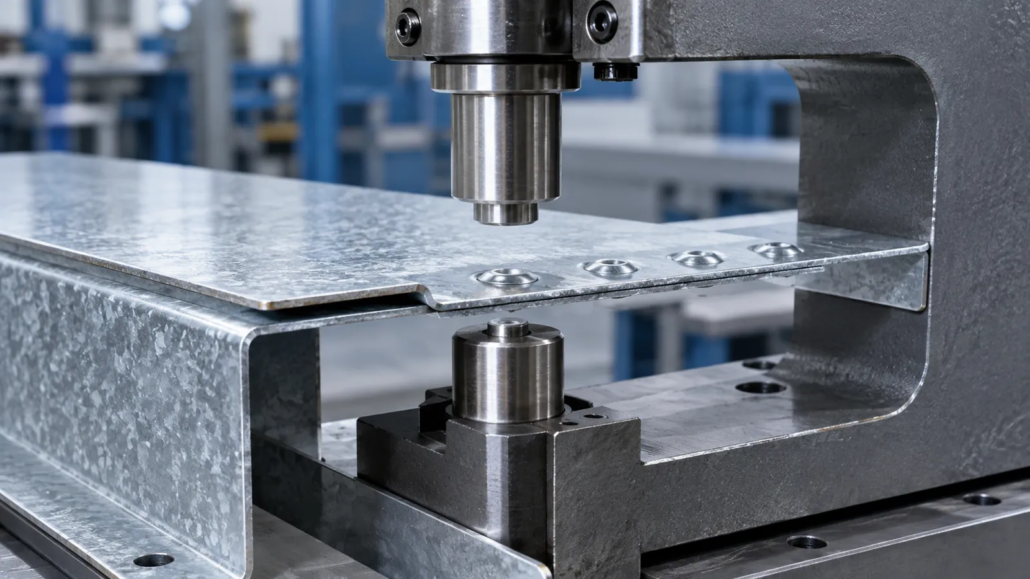
DFM checklist for selecting the right joining technology
Before specifying laser welding (LBW) in the drawing title block, check the following requirements:
- Does the upstream process (precision stamping or laser cutting) guarantee a gap between parts of less than 0.15 mm along the entire length of the joint?
- Does the planned clamping fixture rigidly hold the faces so that local expansion during welding does not open the joint?
- Has the optical reflectivity of the material (especially pure copper or refractory aluminium alloys) been assessed to size the wavelength and power of the source?
- Is the extra cost of amortising the laser cell offset by documented elimination of post-processing time (rework) and shorter cycle times?
Conclusion: how to select the right joining technology
Laser beam welding does not replace traditional technologies by default; it clearly outperforms them when the competition is about pure speed, dimensional control and finish quality.
Specifying laser for parts with poor fit-up only leads to frustration on the shop floor and high costs of poor quality. Conversely, when stamped parts are designed from the outset with tolerances suited to a perfect fit, laser becomes the most powerful lever for eliminating subsequent manual work and turning a complex assembly into a highly profitable robotic process.
How to choose the right joining technology with EDSAONE
Process selection should start from the functional requirements of the joint, the part geometry, the available tolerances, the materials and the expected volume. Assessing these variables during the design phase helps compare alternatives before the manufacturing process is fixed. At EDSAONE, this DFM approach guides the technical discussion around the needs of each project.
Do you need to assess a joint for a metal component? Contact the EDSAONE team to review your project requirements and manufacturing options.


